
Everyday, bit by bit, we’re all building towards something.
We sat down with three people to find out what they’re building and why it's special to them.
AFL legend Dyson Heppell, sparkie and sourdough savant Theo Loizou, and sports presenter Jarra Davis have all taken very different paths to building their something, with varying amounts of footy, power tools and fermentation along the way.
Each of their stories starts with something small, but little by little builds into something much bigger.
Watch the series and discover how Theo, Dyson and Jarra built their something.
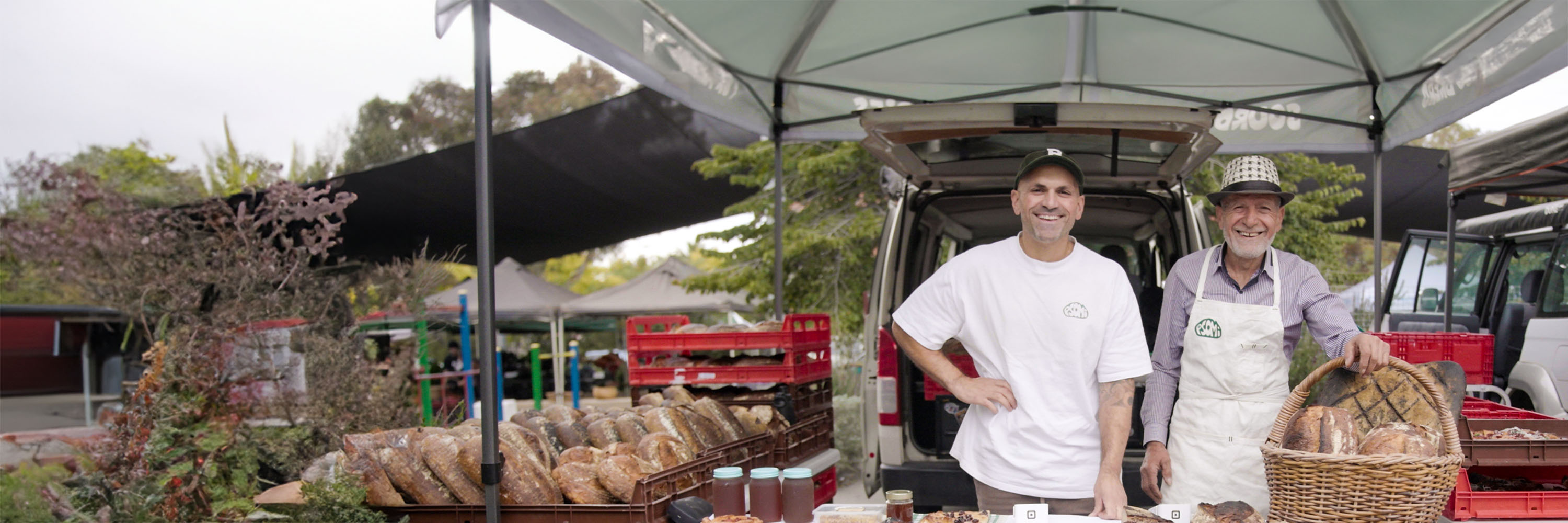
From site to sourdough
Theo Loizou’s story has it all: a failed sourdough. A career change. A one-way ticket to France.
Today, Theo's doing what he loves, creating great bread and building something that started with a simple idea and a lot of persistence.
Watch Theo's story and discover how he built his something
Read the transcript
I'm Theo and this is how I built my something.
The bake day is a big day for me.
I get up, I say up in the middle of the night really, I'm up at 12.30, 12.45am, start baking in the oven and then get everything ready and loaded into the car and then we head to Coburg Farmer's Market which is like an hour away from here, set up our stall and then people come and start buying.
Baking has always been part of my family because my Yiayia, my grandma, used to bake bread all the time.
My dad would bring it home and it was the best day of the week.
So, he'd ring up, he would say I've got Psomi which is the brand name which means bread.
He would eat like half of it on his way home, it was only like 25 minutes away and we would just rip into it and it was just amazing and that stuck in my mind when I was thinking about a hobby. I was quite bored with life.
The first thing I ever baked was a sourdough bread with a starter that just was not working and I didn't realise it and it was like a hockey puck, it was like super flat, really hard. I ate it but it wasn't very good.
It just gave me that little bit of encouragement to be like alright, get better next time.
Originally I wanted to do what my Dad was doing, he was a carpenter and I wanted to follow in his footsteps but I actually hurt my back pretty bad and they told me to choose something else and then someone said to me you should be an electrician. So I went and did that.
The majority of my career I was on big construction sites, in the city, building anywhere from you know laboratories to apartments to UPSs and generators and things like that, so I really did a lot of things in that space but it was all based in the construction world.
I think I started to take baking seriously maybe 10 years ago when I used to be on call, we'd have contract at the airport if there was a breakdown of some sort of equipment or power I would have to go out there and fix it.
And I'll never forget that I had a sourdough bread that was fermenting and I got a call saying you got to go out to the airport.
I said I'll just take my dough with me so I had the dough in the car, had the heater on so it would be a nice warm spot for it and I went and did some work, came back, did a set of folds on it then luckily I'd finished the job, drove it home and did it and I thought well this has now become more than a hobby, it's like an obsession, I can't, I need to do this more than one day a week.
You know my parents would be mortified if I was to change careers and you know I was earning good money, have a house and you know, just be silly to throw that away or throw that away I should say in inverted commas because yeah I just thought that was it, I was 33 years old when I decided to change careers.
I used to go to France and I always wanted to go to this bakery but it was always closed in August because they take the whole of August off and I thought you know I'm going to rent out my house and if I can rent out my house I want to go live in France and learn how to bake bread.
I emailed this bakery that I've been wanting to go to because I'd saw it on an Anthony Bourdain show and I emailed him.
I said I really would love to come and work for you and he emailed back and he was like well what are you talking about? You're from Australia, I don't even know you, you don't have a visa.
Then I just kept emailing him photos of what I was doing, I was getting a lot better, the sourdough was really looking good, I kept sending him photos once a week and then one day I was working at the airport and I got an email from him saying if you want that job it's there for you.
And I just emailed back and said yeah I can be there in six months time because I thought I'd need time and he emailed back and he said I need you at the end of the month.
All my friends thought I was crazy, they were like have you spoken to this guy on like FaceTime or anything like that? And I was like no? and they're like, oh you're getting catfish for sure. He's gonna take your kidneys and you know and then yeah the only time I got a little bit nervous was when I was on the flight over.
I'd packed up my house, I rented it out, I got to the airport with my parents and I was like what am I doing? Like, this is mental.
I'll never forget I got to Paris, I had two massive bags because that was my whole life and I walked into this bakery and I looked around because I knew what he looked like and I was like is Christophe here and they couldn't understand me and he popped his head around the corner and he's like Theo welcome! And I was like oh thank god he's real and then he sort of took me under his wing and gave me an apartment to live in that was five minutes from where I was working which was incredible and yeah that was it was an amazing experience.
I made a call to stay in France after about nine months of living there because I actually fell in love. That was why I stayed for three years and that was the best decision I could have made.
I experienced more of the baking world and I got to fall in love with my now fiancée.
The first time that I sold one of my breads in the market was an incredible incredible day like I was on I was on cloud...whatever. Further than nine I don't even know where I was. Just seeing people that love my product buying it, just seemed so wild to me. But at the same time I knew that this is what I wanted to do and it just was confirmation that it's good and I think it's the return customers now they come back, and they're like we had this bread last week it was the best bread we've had! and that is just...that's incredible. like that's you can't explain that.
Moving to France was a big leap in my life it was a big change but it was a little step onto where I wanted to be and if I hadn't have done that, I wouldn't be where I am today.
After the final siren
For Dyson Heppell, some of life's biggest lessons happened away from the game.
Dyson discovered that building something isn't about having all the answers. It's about backing yourself, learning as you go and finding purpose in the things that matter most.
Check out Dyson's story to see how he built his something.
Read the transcript
Hi, I'm Dyson, and this is how I built my something.
Yes, I played for the Essendon Footy Club for 14 years, and I was a skipper for six years from 2017 to 2022.
When I first came into the AFL environment, life outside of footy didn't really exist.
It was, I was so committed to getting the most out of my career, and I was quite obsessive around footy itself.
And look, it wasn't until I matured and grew and understood that footy is not everything, and there's so much more to life on the outside that I started pursuing other interests and yeah, and made sure I didn't wrap my entire identity in footy itself.
Look, it took me a while to find my own authentic leadership in the role.
You know, a lot of challenges throughout my tenure as captain, but I grew a hell of a lot as a person and as a leader throughout that time.
And the captaincy, you know, really helped me grow up as a person, but also it helped me foster and cultivate skills for life outside of footy too.
Righto, well, we're sitting at the old stands at Windy Hill, and we've got our Hall of Fame legend plaques that have been put on the old seats.
This one's Hurdy's.
Hurdy was my childhood hero growing up, also my first coach. And just a genuine all-round legend.
He's become a good friend and mentor of mine post-retirement as well, which is pretty cool.
You know, I think part of my nature is wanting to make sure that everyone else is OK.
So when there was, you know, some heavy periods throughout the footy club or whether we weren't performing as a team or even individually, I'd put a lot of pressure on myself to make sure the club's in a good position, to make sure the boys are going OK.
And then sort of found myself at times sacrificing my own performance and mental well-being to take care of others.
So that was a period of learning and growth as well, to try and flip that on its head to ensure that I got myself in a really good, healthy mental frame of mind, physically feeling great.
So I had more energy and juice to give to others.
The first day after it ended.
Well, I remember the day after I announced my retirement, Kate and I were walking down to the beach with the dogs, as we do most days.
And there was a pod of about 100 dolphins came pinging through the water down here in the bay.
And for me, it was a bit of a sign to know that I'd made the right call.
I've got a little dolphin tattoo on my leg and I'm big spiritual like that.
So the dolphins came out to say, happy days, you've done well.
This quarter zip. Quarter zip, that one's sick. That's actually come up so well.
I love this one, it's my favourite.
Throwing things back to before I got drafted, my grandmother, my Oma, mum's mum passed away from a condition called scleroderma, which is an autoimmune disease.
When I got drafted, I became an ambassador for the Scleroderma Foundation.
And through the foundation, they introduced me to the young Harrison, little h-man he's known as. He was a mad little Essendon fan.
I was his favourite player and they brought him out to the hangar, to the club and meeting this kid, five years of age and seeing the amount of love that he had for other people, his enthusiasm and just joy for life.
I was genuinely inspired by this kid and wanted to get to know him as much as I possibly could.
And at the time, speaking with his family, they gave him two years to live.
And part of me was like, OK, how can we try and impact this kid's life as much as we can for whatever he's got left?
And as time went on, if I had little injuries or whatever, Harrison would draw me little artworks and pictures and designs and anyway, my wife Kate and I, we decided to, yeah, we thought, what can we try and do here to really make an impact on this kid's life?
And we came up with the concept of a clothing label called Haych, Haych the Label.
And all the artworks, graphics, slogans that he had sent us over the years, we then utilised as the graphics on the kit.
And then the proceeds of sale would help go towards ticking off his bucket list items.
And yeah, we've done some incredible things with little h-man from, you know, bombing around in Lamborghinis to helicopter rides and meeting NBA players.
We sang a song with Teddy Swims and met Ed Sheeran and got him on a private jet and played tennis with Nick Kyrgios and like all these crazy things that are half my bucket list items too.
Yeah, just amazing to see the joy that he's getting from this as well.
And, you know, very grateful to have Haych in my life to, you know, I guess it's helped me enormously in terms of my transition post footy, but also just in my life to have amazing perspective and gratitude for the position I'm in, my health, and just gives me a lot of mental resolve and resilience to attack any challenges that arise.
How are you? Good to see you, my boy.
Well, I'm very much a future thinker.
So for me, I always wanted to have this grand plan and a big vision of what I wanted to achieve.
But I think once I broke it down and go, just start chipping away at these step-by-step processes in terms of setting my new daily routine up, whatever that looked like for me.
But then also from a career and business perspective, it was nice to strip it back, just have little daily steps to chip away at to eventually get to a point where I got into a nice little flow and rhythm in terms of what I was building.
You should have said turn these fingers and I got this one.
Everything and anything there is to do with business, I've had to learn from scratch.
And it's given me an unbelievable appreciation for anyone that's had a crack at starting their own business and, you know, pursuing it as far as they possibly can, because it's not an easy caper, that's for sure. We've certainly found that out.
And it's always got its challenges and things that pop up.
But yeah, at the same time, it's, you know, I think just backing ourselves, knowing that we can, you know, we can do it. We can figure it out on the fly.
And if we can't, there's people there that can that have been there before.
So we're happy to lean in and lean on others and ask questions and get as much advice as we possibly can.
So yeah, that learning on the fly as we go, we're still learning.
What have I learned most from Haych?
Well, one, from the kid himself.
I've learned that no matter what you're facing, no matter what challenges you're going through, you can always find a way to find small things to be grateful for and live an amazing life, because this kid gets after it like no one I've ever seen.
And two, from Haych, the business itself.
I've learned that business can be a hard caper, but with great support and great people around you and belief in the product that you're producing or what you're putting out, that you can absolutely make it work and can be a great success if you have a real passion and excitement towards it.
Breaking into the game
From a uni dorm room to reaching hundreds of thousands of sports fans, Jarra Davis didn't build his something overnight.
Today, Jarra is one of Australia's most recognisable sports creators, but he still approaches every piece of content as a fan first.
Watch Jarra's story and discover how he built his something.
Read the transcript
Alright, let's go.
Hi, I'm Jarra and this is how I built my something.
I think I started creating content because I saw a huge gap where I wanted to watch something. And that something just did not exist.
There was a lane, there was a piece of content, there was a style that just wasn't out there in Australia.
It was around the world and I was looking at it going, why can't we get that coverage here in Australia?
And I was like, okay, someone's going to do it.
Why can't I be the one that does it?
Today, we answer all of the discussion. We answer all of the questions.
How do I take a really convoluted, context-heavy subject like sport, like all the stories around sport or team analysis or tactics and answer all of those things and break it down so that a fan, a casual fan can just completely understand it in a minute and 30 seconds.
So Geelong versus Brisbane is going to be fascinating, mostly because Geelong haven't really shown any weaknesses.
It was me, a single tripod, like a really old-school iPhone just in my uni dorm room, essentially.
Yeah, very cold and a bit lonely and a bit depressing at times.
But, you know, that's where you've got to start. You've got to start with something.
So it started awkward and it started weird and it started out not looking very good at all.
And slowly we're building to something that looks a little bit more polished, but still keeps that same energy of by the fans, for the fans.
It actually just makes no sense.
But the real question is, why does it make no sense?
So for the first six months, I only had a TikTok account and I had maybe 20 followers for six months.
It was grim.
It was grim times, like Year 12, first-year uni, and you're making TikTok videos to an audience of 20 people.
It's a hit to the ego a little bit.
And I always avoided Instagram because all my friends followed my Instagram account.
I didn't want them to see what I was doing.
And then we built that slowly and slowly, and just that consistency and posting all of the time and finding my voice and building that confidence.
And now it's three to four times a day across different platforms every single day.
And building that consistency just puts yourself or puts your face and your image and your voice in front of the audience just over and over and over again.
They start to trust you and you build that community.
And then by building the community, that's how you build, I guess, somewhat of a career from it.
I think like every other kid, I wanted to be a player. I wanted to be a superstar.
I wanted to win a grand final, win a premiership.
I quickly realised that I was nowhere near good enough to actually play the game.
So I thought, I sort of gave up a little bit.
And then as I started posting videos online, I was like, maybe I could crack into footy media.
And it was hard because you look in footy media and it's ex-Hall of Famers, it's 300-gamers, it's Brownlow Medalists, it's premiership players.
And it's like, well, I can't be that.
So I never really thought that there was a path to being in footy media until last year and I sort of cracked a little way in.
And now I'm just trying to turn that little foot in the door and really burst through it as sort of a newcomer on the scene.
I never thought that me talking to my phone could become a career.
Like I've wanted to be a lawyer my entire life.
So I went to uni to be a lawyer and then suddenly fell into this media space.
And when I got my first brand deal, I was like, oh, this is cool.
Like some brand sent me a product and all I've got to do is talk about it and they'll give me free clothing.
And it's still a question now, like can I build this into a career?
That's still a question that I have every single day, but it is looking like it can be a career now, which is exciting and terrifying at the same time.
So this is Windy Hill. Did you play here? Was it pre-season matches?
So my first two years when I got drafted were here.
It feels like I'm still a fan.
Like I still want to be a fan of the game. I still want to love the game. I still want to love sport.
I still want to have the perspective of a fan.
So it feels nowadays the exact same as it did five years ago.
I still watch the game and I'm still in love with the players.
Like I still get starstruck when I meet players.
I still go to the games and I still want to sit up in level four and have a beer and cheer loudly and all of those things.
I still feel like now I'm still just a huge fan.
I'm just a fan with, you know, internet access really.
Sitting on a desk, it's strange. It's really strange.
Like I sit in an office chair and there's a laptop screen in front of me.
And now there's 16 bright lights and there's four different camera angles and there's someone in your ear and there's a microphone strapped to you.
It's a completely new medium. It's a completely new feeling. But it's just another skill set to build. It's another piece of confidence.
Like it's just something that I'm going to look back on in two years and be like, yeah, I built that skill set. I took that next step.
I took that leap of faith and maybe it'll work.
Probably for me projection is a big thing in a studio, and a bigger studio too. Just upping it a bit.
I'd almost say you've got to be a little bit over the top and have connection with camera.
Every time I press record, it feels the exact same as it did day one.
Maybe I speak a little bit clearer or the videos are a little bit more polished, but it's the same voice. It's the same understanding.
It's the same passion for sport. It's the same goal.
Talk about sport in a way that the majority of people can understand.
Like no one's going to know what it's going to end up building towards.
No one's going to know what it's going to end up being.
But if you don't start, then there's no chance it's going to build to anything. So you just have to start.
Whatever it is, you talk about anything, you can build whatever you want, but it's not going to happen until you actually just start and try something and throw something at the wall, and eventually, if you're passionate about it, something will stick.