
What is salary sacrifice?
Salary sacrifice is a simple way to add extra to your super. To set this up, ask your employer to send part of your before‑tax pay straight into your super account.

Salary sacrifice at a glance
Salary sacrifice is easy to set up with your employer.
Your employer pays part of your before‑tax salary into your super.
Before‑tax contributions may reduce the tax you pay on your take‑home pay.
Salary sacrifice counts toward your before-tax (concessional) contributions cap.
Grow your super balance
Extra contributions can make a real difference over time. With compounding returns, even small amounts added now can grow into more savings for your retirement.
Learn about compounding returns.
A lower tax rate
Salary sacrifice contributions are generally taxed at 15%.
If your combined income and concessional contributions exceed $250,000, extra tax will apply.
Because these contributions come from your before‑tax pay, your taxable income is lower. This can reduce the tax you pay, especially if you’re on a higher tax rate.
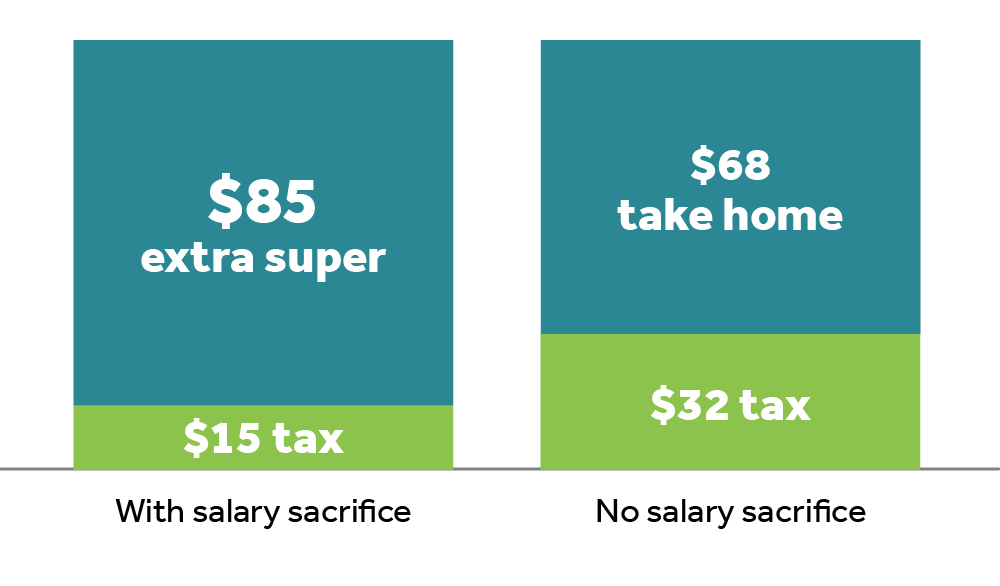
How salary sacrifice can save on tax^
- Sam earns $60,000 a year and sacrifices $100 from his pay each month
- Of that $100, $85 goes into his super. $15 is deducted as a contributions tax
- If Sam took the $100 as salary instead, he’d pay $32 in income tax* and be left with $68, with no extra super.
^ Examples are for illustrative purposes only.
* Marginal tax rate of 30%, plus Medicare levy of 2%.
1. Complete the Salary sacrifice form
- Decide how much of your salary you’d like to contribute each pay cycle. You can choose a dollar amount or a percentage.
- The contributions calculator can help you decide what works for you.
- Download and complete the Salary sacrifice form (PDF).
2. Give the form to your employer
- Share your completed form with your employer or payroll team.
- They’ll set up your salary sacrifice based on your instructions.
What happens if I go over the before-tax contributions cap?
If you go over the before-tax (concessional) contributions cap:
- The amount you go over the cap is added to your assessable income.
- It’s taxed at your marginal income tax rate, less a 15% tax offset
- If you don’t withdraw this extra amount, it counts towards your after-tax (non concessional) contributions cap.
Learn more at the ATO.
Do I need to claim a tax deduction for salary sacrifice?
No. Salary sacrifice contributions are made by your employer from your before-tax pay. Your pay has already been taxed, so you don’t need to claim a tax deduction. Instead, you should see less tax paid on your payslip.
Salary sacrifice is an employer super contribution. It may be included in income tests used to work out benefits, concessions and offsets.
Does salary sacrifice count towards my contributions cap?
Yes. Salary sacrifice contributions count towards your concessional contributions cap. The super your employer pays (the Super Guarantee) also counts in this cap.
Keep an eye on your contributions so you don’t go over the cap. You can check your contributions in your online account.
Learn more in the Making super contributions fact sheet (PDF).
Salary sacrifice explained
Salary sacrifice is a practical way to:
- Pay less tax on your take‑home pay.
- Grow your super balance over time.
Watch the video to find out more about salary sacrifice.
Join an information session
Our information sessions explain your options so you can boost your super with confidence.
Get advice
Our Advice team can help talk you through your options and answer general questions about contributions.